- At the Fórum Europa Tribuna Catalunya, the Minister for European Union and Foreign Action, Jaume Duch, announced that the Generalitat’s upcoming Strategic Plan for Foreign Action and EU Relations will be a “national plan” open to society.
- Duch also reaffirmed the Government’s commitment to multilateralism, offering Catalonia as a host for United Nations agencies: “We can be home to international organisations that are now more necessary than ever.”
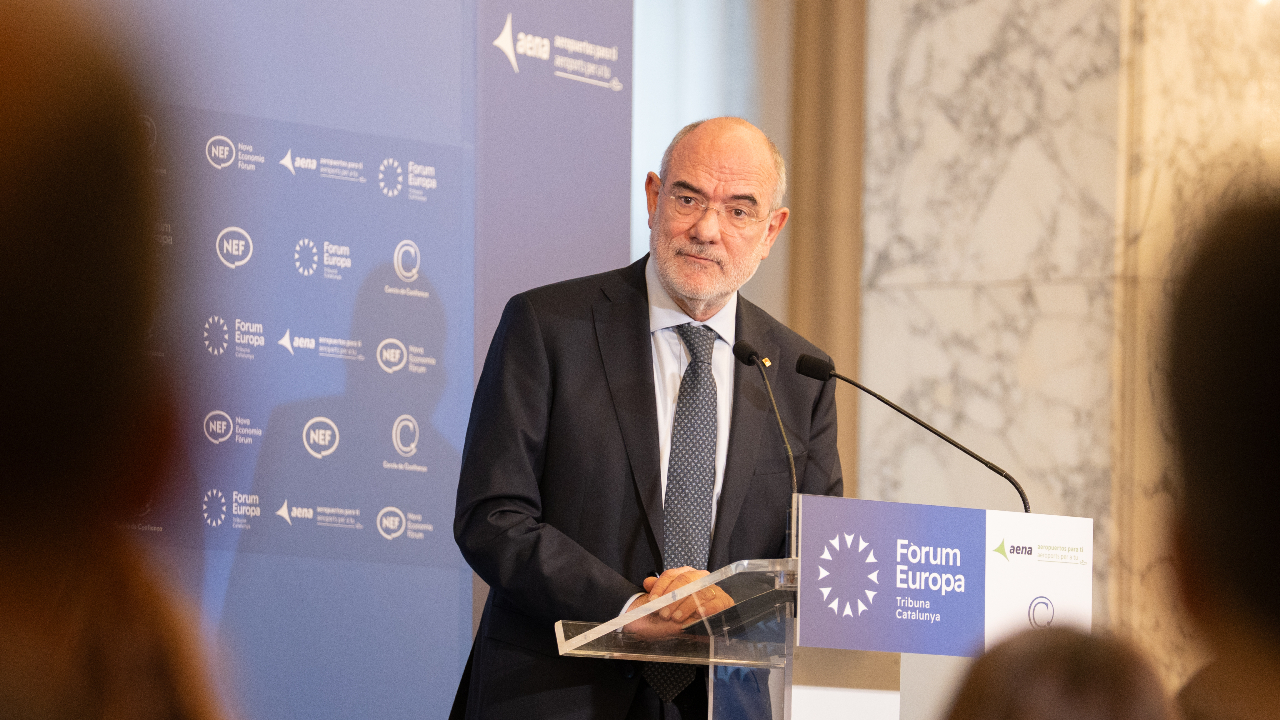
The Minister for European Union and Foreign Action, Jaume Duch, took part on Monday in the informative breakfast organised by Fórum Europa Tribuna Catalunya, part of the Nueva Economía Fórum, where he reflected on the role of the European Union—and of Catalonia within it—in the current international context.
In what he described as a “turbulent, more fragmented, and much more uncertain” world, marked by changes affecting “fundamental pillars” such as democracy and international law, Duch stressed that Europeans “cannot afford to be naïve or divided.”
“We need a Union that is far more politically and economically integrated, more autonomous in many areas, and morally reinforced to maintain its democratic strength,” he said.
For Duch, this means the EU must have “its own decision-making capacity” in critical areas such as security and defence, access to energy and key technologies, while continuing to build the Union by deepening the internal market, completing the banking union, and improving decision-making processes so they require fewer unanimous votes and can be faster.
“This is about defending Europe in the current international context,” the minister said, adding that this requires “a roadmap, the necessary resources, and political will.” “The roadmap exists,” he noted, referencing the Draghi, Letta, and Kubilius reports, “but the resources do not.” He argued for a new Multiannual Financial Framework that is “highly ambitious” in research, innovation, strategic infrastructure, competitiveness, industrial sovereignty, semiconductors, batteries, and biotechnology.
Finally, political will is, according to Duch, “fundamental” and “seems to be emerging” as “a certain naivety is being abandoned.” “We must be able to defend ourselves more clearly,” he insisted.
To achieve all this, Duch emphasised the need to involve citizens: “We need to connect with people’s real, everyday concerns,” such as housing, security, or artificial intelligence. “If we want a geopolitically strong Europe, we must be able to respond to the needs of its citizens,” he added.
Catalonia’s role
In this context, the Minister for EU and Foreign Action said, “It would be a mistake to think that only states should act and can be influential.” Catalonia and other European regions with significant self-government and “dynamic, vibrant societies” can also “play a role.”
Accordingly, Duch announced that the Generalitat’s next Strategic Plan for Foreign Action and EU Relations 2027–2030 will be “a genuine national plan,” aiming to be “as open and participatory as possible.” Specifically, the Government wants contributions from institutions, universities, research centres, business organisations, trade unions, and other entities linked to foreign action: “They will help draft the plan and, of course, implement it.”
The plan will guide the Government’s and the country’s foreign action over the coming years and help “tackle major global challenges together.”
The Government aims to have “presence, influence, and leadership” in the EU on three complementary levels: within EU institutions—at the Committee of the Regions, the European Parliament, the Council of Ministers, and the European Commission; through regional networks—such as the Four Motors for Europe and other thematic networks; and via the Government’s Delegation to the EU. Priority areas include the Multiannual Financial Framework and cohesion policies, fisheries policy, technological transformation, and the official status of Catalan.
Commitment to multilateralism
Duch also focused on the wider world and reaffirmed the Government’s commitment to multilateralism.
“We are witnessing the abandonment and discrediting of a rules-based world, which is unfortunately beginning to resemble a world governed by the law of the strongest,” he said. In response, “we will work to strengthen the international multilateral system, for example, through our agreements with UN agencies, which we will reinforce in the coming months.”
“While some are withdrawing from the UN and removing their support,” he continued, “we want to be even more committed.” For this reason, Catalonia has “the capacity and the willingness” to host UN agencies or organisations seeking a new location. “Catalonia can be home to some of these international organisations, which are now more necessary than ever,” he emphasised.
Looking beyond Europe, Duch also outlined the Government’s efforts to diversify relations. He highlighted economic engagement in new markets to “reduce dependencies” and “create real opportunities” for the country’s productive sectors. He also referenced the development of new regional strategies, including the recently approved Asia Strategy and the upcoming Strategy for Latin America.