- Barcelona hosted, for the first time, a session of the OECD’s Water Governance Initiative (WGI), promoting the exchange of best practices in water management.
- Minister Jaume Duch welcomed the OECD’s choice of Catalonia for this high-level seminar: “It reflects the recognition that regions and cities are essential actors in water governance.”
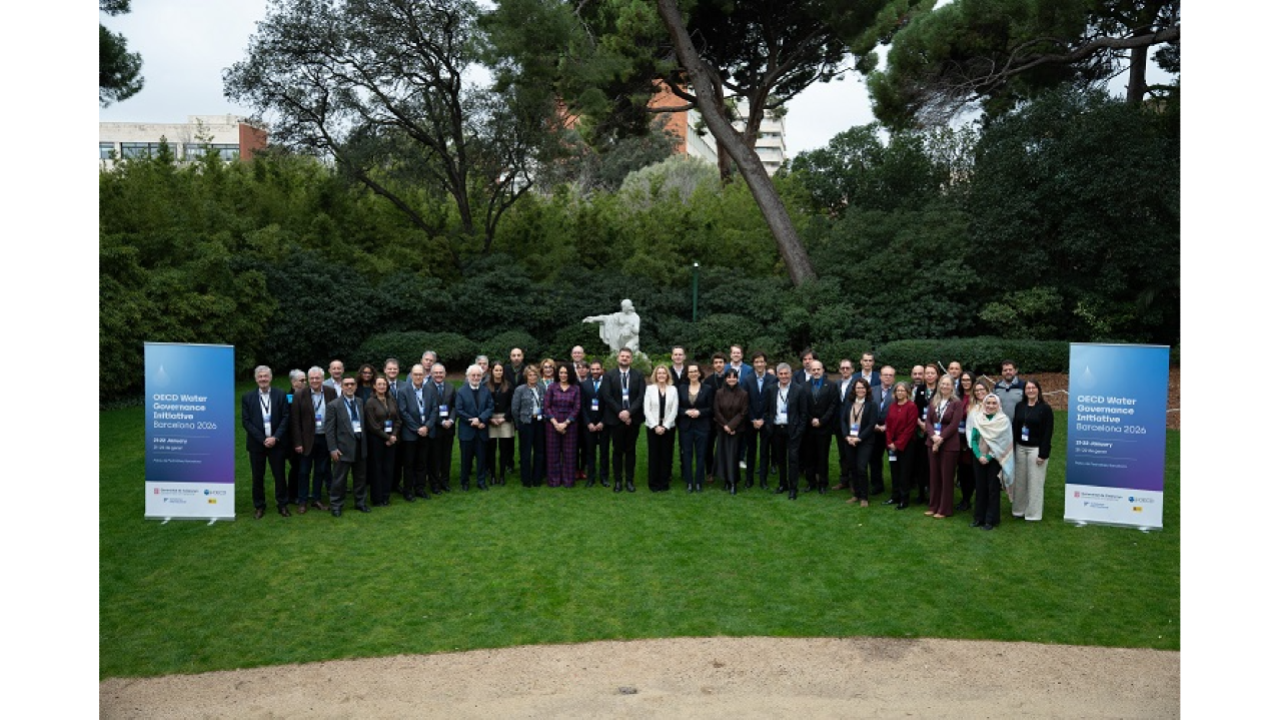
Barcelona recently held its first meeting of the Water Governance Initiative (WGI), the international network of over 100 members established by the OECD to share best practices and improve water governance in the current climate crisis.
This was the 21st meeting since the initiative was launched in 2013. It was organised by the Generalitat’s Department for European Union and Foreign Action at the Palau de Pedralbes, with support from Catalonia International and the Spanish Government.
Minister for European Union and Foreign Action, Jaume Duch, described the meeting as “a clear reflection of Catalonia’s commitment to multilateralism.” In today’s international context, where “the pillars of the multilateral system are being questioned,” he argued that it is vital to “preserve and strengthen dialogue spaces based on trust, data, and consensus” to tackle global challenges.
Effective governance, according to Duch, requires regions and cities to work alongside national and international actors. Hosting the WGI meeting in Barcelona represents “recognition that regions and cities are essential actors, in this case in water governance.”
Highlighting Catalonia’s water management
Participants included representatives from the Catalan Water Agency (ACA), who showcased Catalonia’s management during the drought from 2021 to 2025, as well as the region’s strategy for the water transition. This strategy aims to ensure that within five years, 70% of water demand will be met through new resources such as desalination, water reuse, and network efficiency improvements.
A crucial year for water governance
Members of the WGI—including government representatives, international organisations, NGOs, international financial institutions, academics, and independent experts—shared information on the impact of climate change on the water cycle.
Barbara Pompili, WGI Chair, warned that according to the latest OECD projections, by 2050, more than one billion additional people will live under water stress conditions. Even with improvements in water-use efficiency, global water demand is expected to rise by more than 20% due to population growth, urbanisation, and economic development.
In this context, participants emphasised the importance of the three upcoming United Nations climate conferences in 2026—on climate, biodiversity, and desertification—as well as the UN Water Conference in December in the UAE, making this year especially important for water governance.
The OECD is preparing an assessment of its Principles on Water Governance, which it plans to present publicly at the UN conference later this year.
Other topics discussed included the opportunities and risks of applying artificial intelligence in water governance, and the promotion of “biocities” with green and agricultural areas to improve permeability, reduce flooding, and lower urban temperatures.
A high-level meeting
The Palau de Pedralbes hosted representatives from European and international institutions such as the European Commission, the UN Food and Agriculture Organisation (FAO), UNESCO, the Union for the Mediterranean (UfM), United Cities and Local Governments (UCLG), and ICLEI – Local Governments for Sustainability.
Delegates also came from governments and organisations in Spain, France, Portugal, the UK, Germany, Austria, the Netherlands, Estonia, Hungary, Turkey, Israel, Senegal, the UAE, the United States, Canada, Brazil, Argentina, and Colombia.