- The Minister for European Union and External Action has welcomed the recognition of “Catalonia’s distinctiveness” and its “unique role” on the international stage.
- The agreement between the Government of Catalonia and the Government of Spain has been formalised with the signing of two protocols by Minister Duch and Minister Albares.
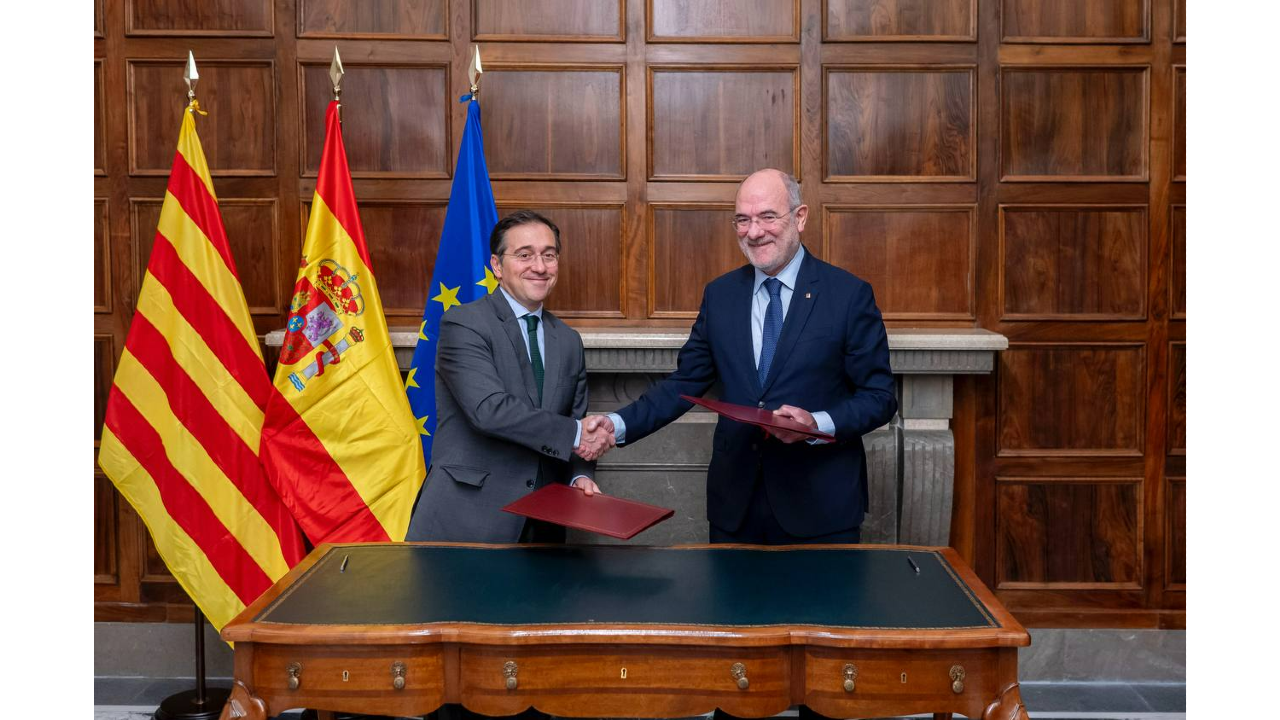
The Minister for European Union and External Action, Jaume Duch, has presented the agreement between the Government of Catalonia and the Government of Spain to incorporate Catalonia as an associate member of UNESCO and UN Tourism, two of the most important international organisations within the United Nations system.
“The status of associate member is unprecedented in Catalonia’s case and, therefore, we consider it to be a very significant step forward,” Duch said at a press conference held this Tuesday at the Palau de la Generalitat. It is a “historic milestone in the external projection of the Government of Catalonia and, therefore, for the country as a whole,” he added.
Through Catalonia’s participation in these organisations, the aim is to “recognise Catalonia’s distinctiveness, based, among other things, on its culture and its own language, which enables it to play a unique role at the international level,” the minister explained.
Catalonia will have a direct influence on all matters that affect it and fall within its areas of competence, which are “practically all areas,” Duch noted, given that these organisations work in the fields of culture, education and tourism.
Very few territories worldwide hold associate member status in these organisations. Within UNESCO, the most notable case is Flanders.
Signing with Minister Albares and the forthcoming ratification
The minister and the Spanish Minister of Foreign Affairs, European Union and Cooperation, José Manuel Albares, sealed the agreement this Monday in Madrid by signing two memoranda of understanding in both Catalan and Spanish: “a highly significant gesture,” Duch pointed out.
In this way, the commitment to open these organisations to the participation of the Government of Catalonia—set out in the investiture agreements between the Socialists’ Party of Catalonia and Republican Left of Catalonia, and between the Government of Spain and Junts—has been fulfilled.
Based on these commitments, Spain’s Ministry of Foreign Affairs and the Generalitat’s Department of European Union and External Action have been working to bring the agreement into effect.
The general assemblies of each organisation will now need to give their final approval in the coming months. In the meantime, however, the signed agreement establishes a provisional statute that has already entered into force and allows for the appointment of an accredited expert to UNESCO before attaining associate member status.
Representatives in Paris and Madrid
Minister Duch explained that, in the case of UNESCO, Catalonia will appoint a councillor who will be integrated into Spain’s permanent delegation to the organisation, based in Paris. This councillor will hold the same diplomatic rank as the other members of the permanent delegation and will take part in all UNESCO work, meetings and conferences in coordination with the rest of the delegation, but “with its own voice, representing the interests of the Government of Catalonia and of Catalonia,” he assured.
Duch also explained that the Government will establish a consultation mechanism with Catalan experts, both from within the Government itself and from civil society, regarding UNESCO’s programme of activities, in order to “support the work” of Catalonia’s representative. In addition, he announced that another Government representative will also be integrated into the Spanish Commission for Cooperation with UNESCO.
In the case of UN Tourism, whose headquarters are in Madrid, the agreement reached will make it possible to appoint several delegated representatives who will participate in all the activities of this international organisation.